Essence
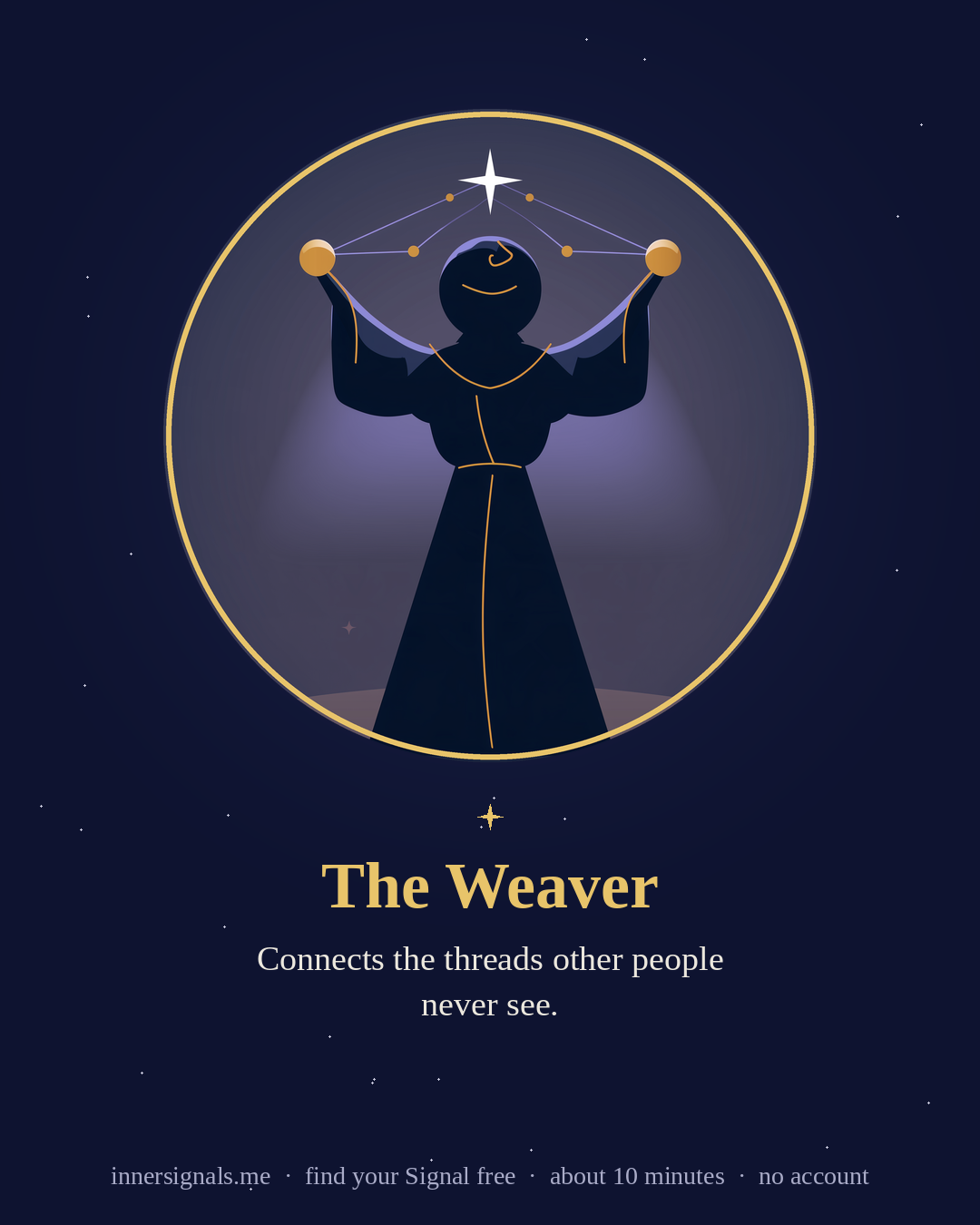
You see the threads between things others experience as separate — people, ideas, events — and you weave them into a picture nobody else can hold in one hand. Patterns are your native language; you don't hear three problems, you see one shape with three symptoms. At your clearest, you connect the dots into meaning, then choose a thread and pull.
Gifts
You synthesise fast and hand people a map that makes their chaos navigable. You're the one who connects the dots into meaning, then chooses a thread and pulls. Your core gift is synthesis — you find the pattern and the meaning in what looks like noise.
The shadow
In static, you see so many connections you can't move. The map keeps growing while the territory waits, and analysis becomes the sophisticated way you avoid the risk of a single decision. It's the endless map: seeing everything, choosing nothing, mistaking the model for the move.
In love
You love by understanding the whole dynamic — you see what's really going on between you and your partner, and you can name it in a way that brings relief, not exposure. The pattern to watch is that you analyse the relationship from above instead of being inside it, warm and unguarded — mapping the connection when your partner just wants you present in it. What you need is a partner who values your insight but pulls you down off the balcony and into the moment — and the growth move is to see that some closeness can't be mapped, only lived: put the diagram down and just be in the room.
At work
You hold complexity nobody else can and hand people a map that makes their chaos navigable — the strategist, the synthesiser, the one who sees the pattern in the noise. You do your best work with genuinely complex problems and space for your inward processing. Friction shows up with pressure for instant answers, open-plan chaos, and no-recovery structures. You're drained by shallow busywork and constant interruption, energised by a tangle worth untangling and quiet to do it in. Best environments: strategy, design, synthesis, the intersection roles without clean names — where making complexity usable is the job.
What a Weaver needs
A Weaver needs a partner who values your insight but pulls you down off the balcony and into the moment. The edge is that seeing everything is not the same as doing something — choose a thread and pull, and remember some closeness can't be mapped, only lived.
You're built to see how it all fits — and to hand people the map that makes their chaos navigable. The problem you're made for is complexity nobody can hold: the tangle of people, systems and causes where everyone sees dots and you see lines. Rooms that need you are strategy, design, synthesis, the intersection jobs that don't have names yet. The condition is that seeing everything is not the same as doing something — choose a thread and pull, because the map only matters when someone walks it.